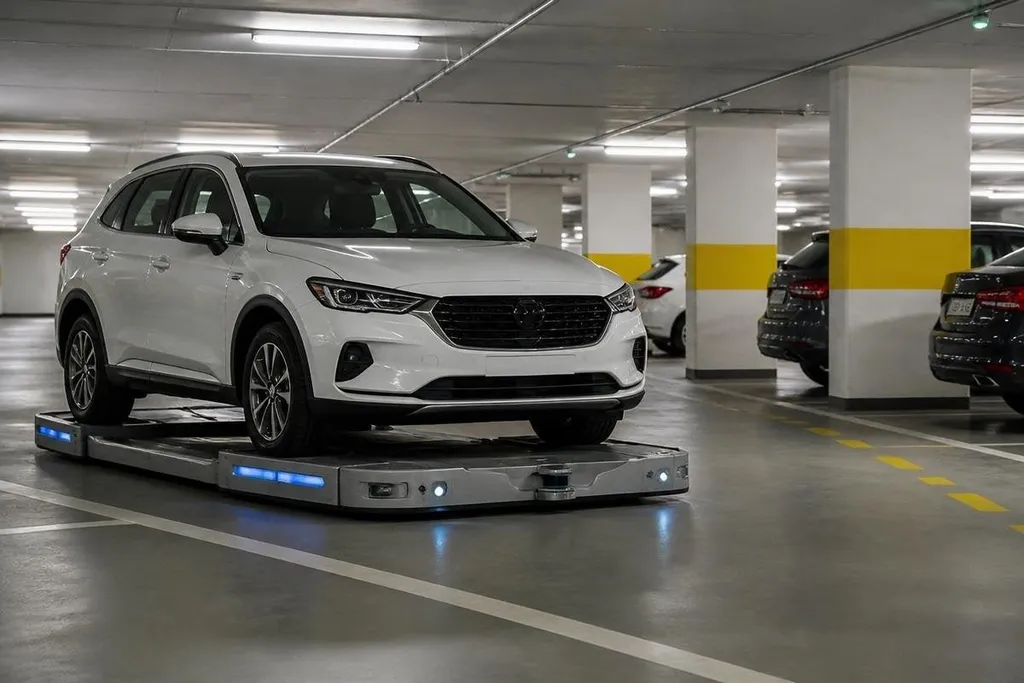
The robot has one job: move a car between a handover point and a marked space, then bring it back when asked.
Future versions will need to handle the parts that make parking hard in practice: mixed vehicle sizes, narrow lanes, people walking nearby, and cars parked slightly out of place.
- Robots may use cameras, LiDAR, or floor markers to locate cars and spaces.
- The handover area must be clear before the system can move a vehicle.
- Safety checks, fault recovery, and car access matter as much as driving control.
How the robot moves a car
These systems can move a vehicle in two main ways. A mobile robot may drive under the car, lift its wheels, and carry it to an open space. Another design may use a fixed platform, lift, or conveyor that shifts the car through the garage.
The mobile approach can fit more easily into an existing car park because it may not need a large set of rails or platforms. It still needs accurate maps, clear routes, and enough room for the robot to turn while carrying a heavy vehicle. The fixed approach can make each movement easier to control, but it may demand changes to the building.
The robot also needs to identify the correct car. A ticket, phone code, license plate camera, or marked handover bay can link a vehicle to a parking request. That link matters when several cars arrive close together, since a wrong handoff would be a serious system failure.
The garage is part of the robot
A parking robot does not work alone. The building supplies lighting, floor markings, signs, doors, charging points, fire systems, and space for people to walk. A system that works in a new garage may need different sensors and rules in an older one.
The handover area deserves close attention. A driver may leave a door open, place luggage near a wheel, or stop outside the marked zone. The robot needs a check that confirms the car is ready before it moves. If the check fails, the system should tell the driver what to fix rather than leave them guessing.
An empty bay proves very little if the robot can’t stop safely when a person or car blocks its route. A parking operator needs the garage, handover point, test date, and fault response behind any claim. Parking robot reports from Robot24.com give those details before the article turns to safety during faults.
Safety has to work during faults
A safe parking robot must react when its normal plan stops working. A person may enter the lane, another vehicle may block a route, or a sensor may return poor data. The robot should stop, report the problem, and wait for a clear instruction or a trained operator.
That sounds basic because it is. The hard part is making the response reliable across the garage, not only during a planned demonstration. Operators also need a way to move a car by hand, release a trapped vehicle, and check the robot without entering an unsafe area.
Security matters too. Each parking request should connect to the right vehicle and the right person. The system needs records of each handoff, movement, stop, and manual intervention so staff can trace a problem later.
What still needs proof
Many parking robot ideas look useful on a floor plan. The buying decision depends on what happens during a full day of real use. A garage owner needs clear answers about installation work, service access, power use, weather exposure at entrances, and what happens when the system is offline.
The business case also depends on space. A robot may let a garage use narrower driving lanes or remove some walking space, but the system itself needs room for charging, turning, storage, and maintenance. Those areas count against the spaces available for cars.
I'd wait for operating records from a site with normal traffic before treating a parking robot as ready for a large rollout.
A buying checklist
Use these questions before choosing a system:
- Vehicle range: Which car lengths, widths, weights, and wheel types can it accept?
- Handover process: What does the driver need to do before leaving the car?
- Fault recovery: Can staff remove a blocked vehicle without special tools?
- Garage changes: Are new floors, doors, markers, lights, or network links needed?
- Service plan: Who checks sensors, batteries, motors, and lifting parts?
- Proof of use: Can the supplier show records from a live site with similar traffic?
The next useful step is a site test with real cars, real drivers, and the garage’s worst route. If the robot can stop safely, explain faults clearly, and return the correct car after repeated requests, the design has earned a serious purchase review.